
Quick answer: If you’re filing in September, your next deadlines are October 31 and November 1, and they cover the majority of U.S. states. Both groups share a July 1–June 30 reporting period, but they are not interchangeable. Confirm which date applies to each state where you hold property before you finalize your filing calendar.
Unclaimed property compliance isn’t a single date, it’s a season. Between March and November, holders face staggered deadlines tied to different reporting periods and dormancy schedules. Miss one and you’re not just late; you’re exposed to interest, penalties, and audit risk.
If you’re reading this in September, your most pressing deadlines are less than two months away. Download the full deadline reference graphic below, then check below to confirm exactly which states you need to file for, and when.
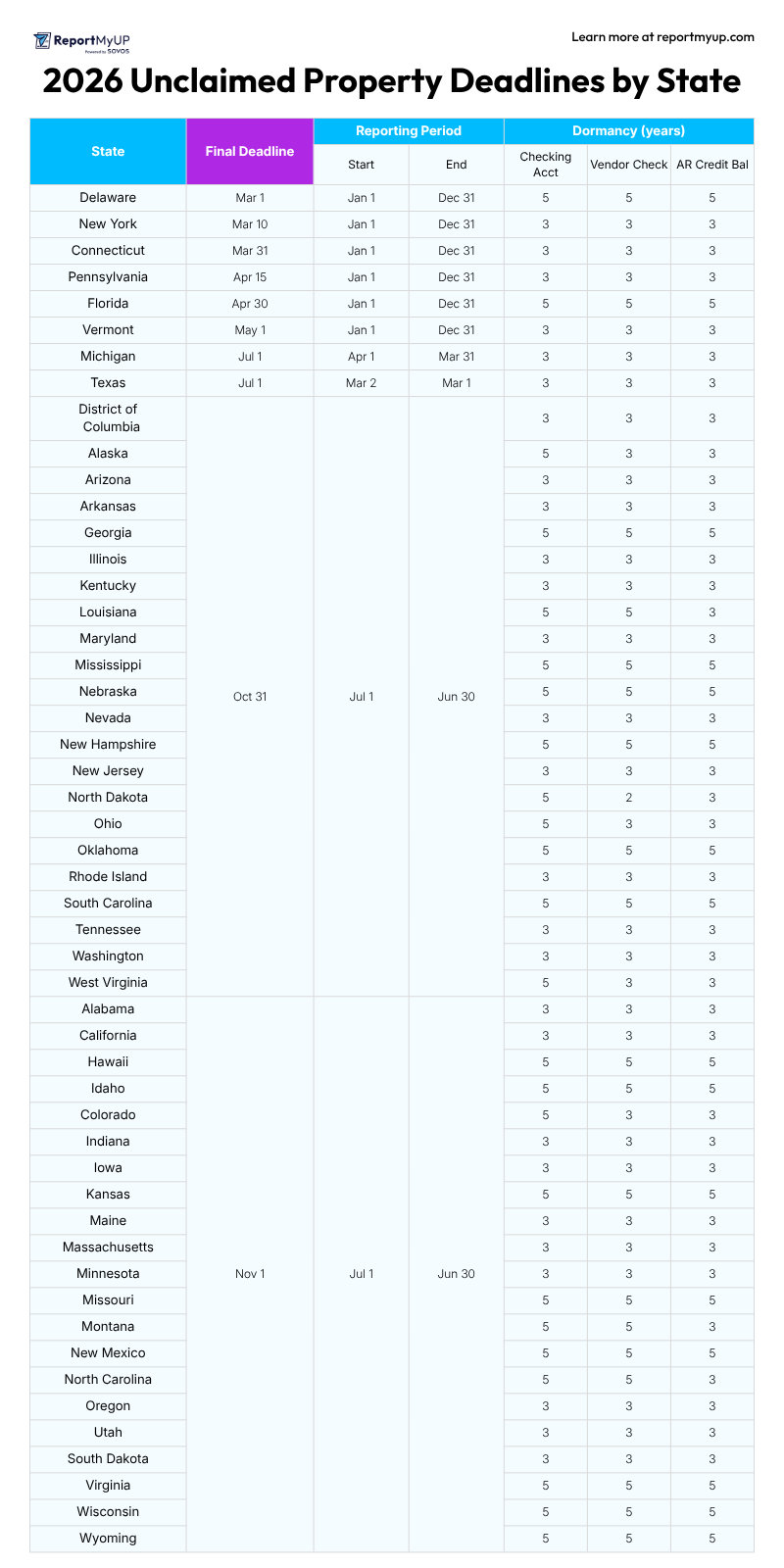
Deadlines Coming Up First
October 31, 2026 → Reporting Period: July 1–June 30
These states require your report and remittance by October 31:
- Alaska
- Arizona
- Arkansas
- District of Columbia
- Georgia
- Illinois
- Kentucky
- Louisiana
- Maryland
- Mississippi
- Nebraska
- Nevada
- New Hampshire
- New Jersey
- North Dakota
- Ohio
- Oklahoma
- Rhode Island
- South Carolina
- Tennessee
- Washington
- West Virginia
November 1, 2026 → Reporting Period: July 1–June 30
One day later, this larger group of states reaches its final deadline:
- Alabama
- California
- Colorado
- Hawaii
- Idaho
- Indiana
- Iowa
- Kansas
- Maine
- Massachusetts
- Minnesota
- Missouri
- Montana
- New Mexico
- North Carolina
- Oregon
- South Dakota
- Utah
- Virginia
- Wisconsin
- Wyoming
Both the October 31 and November 1 groups draw from the same July 1–June 30 reporting period. The property pool is the same window — the due date is not.
Earlier 2026 Deadlines (Already Passed)
For reference, here are the deadlines that fell earlier in the year.
July 1 — Michigan and Texas
Both states share the same due date but use different reporting windows. Michigan’s period runs April 1–March 31. Texas runs March 2–March 1. Same deadline, different property pools.
Spring Filers → Calendar-Year Reporting Period (Jan 1–Dec 31)
These six states file earlier because they run on a calendar-year reporting window:
- Delaware — March 1
- New York — March 10
- Connecticut — March 31
- Pennsylvania — April 15
- Florida — April 30
- Vermont — May 1
What is a reporting period?
The reporting period is the window of time your dormant property is drawn from — not the date you file. It answers “what property counts,” while the final deadline answers “when do I submit it.”
If you operate in multiple states, treat these as two separate tracking requirements. A single annual reminder won’t cover a filing season that spans March through November with different property pools feeding each report.
What happens if you miss a final deadline?
Missing the final deadline means you’ve failed to submit the report and remit funds on time. That exposes you to three consequences:
- Interest and penalties, typically calculated per day or per month past due
- Audit risk, since late filers attract more state examinations
- Full liability for the property value, even if the owner has since claimed it elsewhere
Some states offer voluntary disclosure agreements (VDAs) that reduce or waive penalties for holders who self-report before an audit starts. That window closes the moment a state initiates an examination — don’t wait to find out where you stand.
What does escheatment mean?
Escheatment is the legal process of transferring dormant property to the state, which then holds it as custodian until the rightful owner claims it. For holders, escheatment is a legal obligation, not a best practice. Once property crosses the dormancy threshold and the reporting period closes, you’re required to report and remit it — holding onto it longer creates liability, not flexibility.
Escheatment doesn’t remove your duty to notify owners first. Most states require a due diligence mailing to the owner’s last known address once the property value exceeds a set threshold (commonly $50). This step is meant to reunite property with its owner before it ever reaches the state, and documenting it is part of the filing itself.
Watch: Unclaimed Property 101 webinar
What are dormancy periods?
Dormancy is the length of inactivity after which property is legally considered abandoned. The clock typically starts from the last owner-initiated contact — a transaction, a written inquiry, or a claim.
Dormancy is not uniform. It varies by property type and by state:
- Checking accounts → usually 3 or 5 years
- Vendor checks → often 3 years, though some states use 2 or 5
- Accounts receivable credit balances→usually 3 years, occasionally 5
North Dakota is a clear outlier: vendor checks go dormant after just 2 years, while checking accounts carry a 5-year threshold. Louisiana treats AR credit balances differently from checking accounts entirely. Apply a single dormancy rule across every property type and you’ll either under-report or over-report — neither is a safe outcome.
States also reset the dormancy clock differently. Some reset on any company-side action; others require affirmative owner activity. Getting this wrong doesn’t just risk a missed deadline — it can cause you to report property that was never actually dormant.
Is there an easier way to manage unclaimed property?
Unclaimed property compliance is a multi-state, multi-deadline, multi-property-type problem. The more states you operate in, the more likely one deadline slips through.
ReportMyUP tracks the deadline calendar, applies reporting period logic, calculates dormancy by property type and state, manages due diligence mailings, and generates reports — all in one place. Instead of rebuilding your compliance calendar each year and hoping your spreadsheet formulas held up, ReportMyUP keeps every obligation visible automatically.
FAQ
What is the earliest 2026 unclaimed property deadline?
Delaware has the earliest deadline at March 1, 2026, followed by New York on March 10.
Does every state use the same reporting period?
No. Six states (Delaware, New York, Connecticut, Pennsylvania, Florida, Vermont) use a calendar-year period. Michigan and Texas use their own custom windows. Most remaining states use July 1–June 30.
Is the District of Columbia grouped with the November 1 states?
No. The District of Columbia has an October 31 deadline, distinct from the larger November 1 group.
What happens if I file after the deadline but before an audit starts?
You may qualify for a voluntary disclosure agreement (VDA) in many states, which can reduce or waive penalties. This option closes once a state initiates an examination.
Can dormancy periods change my filing obligation from year to year?
Yes. Dormancy periods vary by property type and by state, and some states reset the clock differently. Review dormancy rules annually rather than assuming last year’s calculation still applies.